About
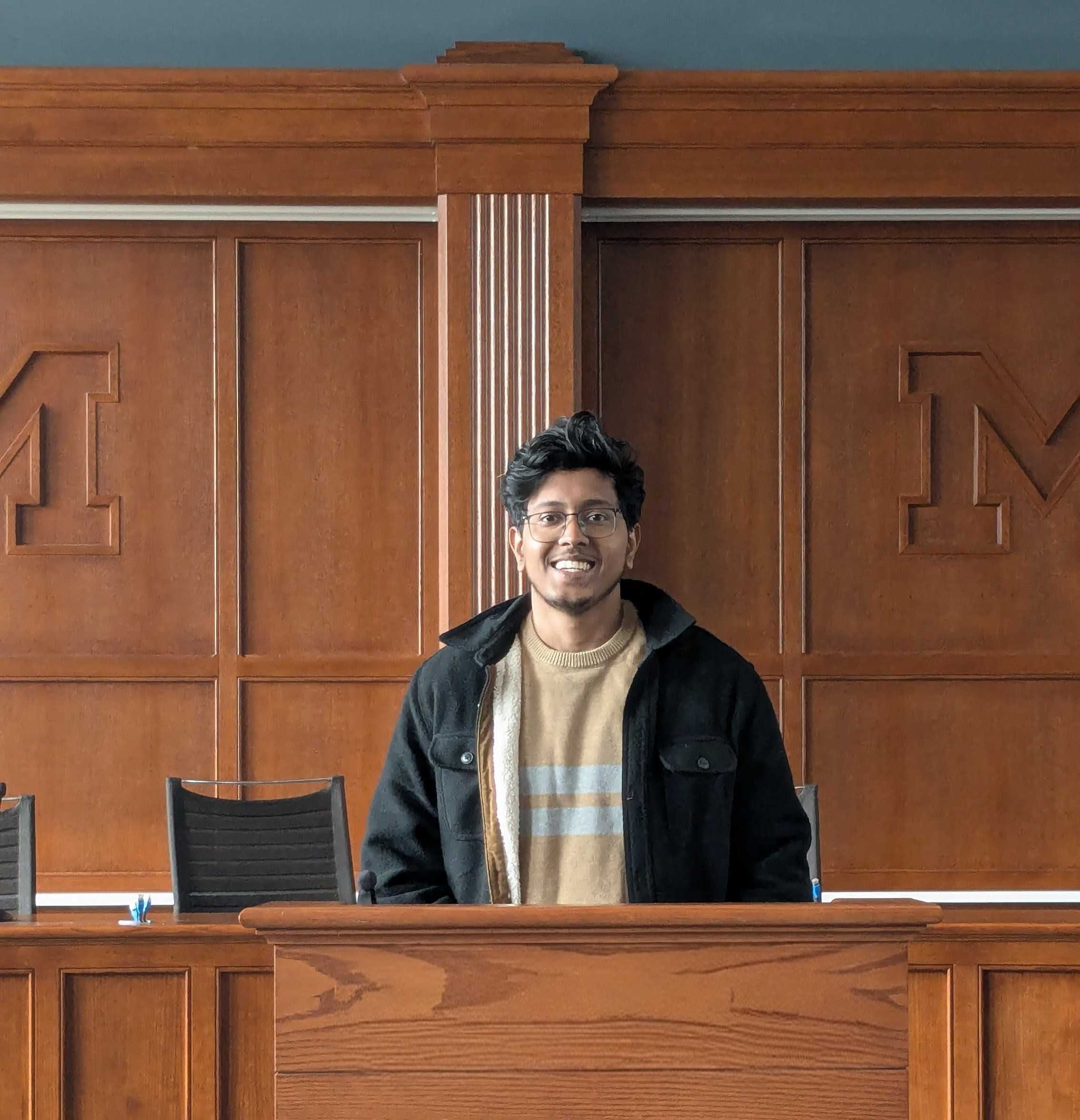
I am a Research Specialist Lab Associate at the Systems Imaging and Bioinformatics Lab in the Department of Computational Medicine and Bioinformatics and the primary bioinformatician at the Pancreatic Cancer lab in the Department of Pathology. I am jointly advised by Dr. Jiaqi Shi and Dr. Arvind Rao at the University of Michigan, Ann Arbor.
Prior to this, I completed my Bachelor’s and Master’s degrees in Biomedical Engineering at IIT (BHU), Varanasi, India, in 2023.
Research
In Dr. Jiaqi Shi’s lab, I study how alterations in key epigenetic regulators, specifically KMT2D and KDM6A shape pancreatic cancer progression. As the lab’s bioinformatician, I lead the analysis of epigenomic and transcriptomic datasets to characterize how chromatin remodeling influences cellular identity, plasticity, and state transitions. This work aims to uncover the molecular mechanisms and cellular heterogeneity that drive tumor evolution and therapeutic resistance in pancreatic cancer.
In Dr. Arvind Rao’s lab, I develop computational and mathematical algorithms for biological network inference across large-scale transcriptomics data. My research applies concepts from quantum information theory and quantum computing to model biological networks. Although genes and cells are not quantum systems, regulatory and signaling networks frequently exhibit non-local correlations, contextual behavior, and entanglement-like dependencies that resemble quantum phenomena and are difficult to capture with traditional statistical models.
Recent News
- Feb 2026: Co-authored journal paper titled "Elevated TIGIT Expression and Immune Cell Dysfunction Characterize COMPASS-like Complex Gene-mutated Pancreatic Ductal Adenocarcinoma"[link]
- Dec 2025: Presented a talk titled “Chromatin Accessibility Shifts in Epithelial Cells Following KMT2D Loss in PDAC” as part of the PanTERA Seminar Series at the Rogel Cancer Center.
- Nov 2025: Spatial multi-omics reveal distinct immunosuppressive lipid-laden macrophages in primary CNS lymphoma compared to systemic DLBCL[link]
(American Society of Hematology: ASH – oral presentation) - Sep 2025: Abstract: TIGIT-mediated immune suppression in KMT2D-mutant pancreatic cancer[link]
(American Association for Cancer Research: AACR) - Sep 2025: Abstract: Epigenetic Tumor Suppressor KMT2D Shapes the Immune Landscape in Pancreatic Cancer[link]
(American Association for Cancer Research : AACR) - Sep 2025: Abstract: KMT2D Loss Induces Enrichment of Plod2+ Fibroblasts in Pancreatic Cancer[link]
(American Association for Cancer Research: AACR) - Jul 2025: Accepted conference paper titled "QubitLens: An Interactive Learning Tool for Quantum State Tomography"[link]
(QSEEC IEEE Quantum Week, ABQ) - Jun 2025: Gave a talk: “Simplifying quantum state tomography using maximum likelihood estimation”[link]
IEEE International Symposium on Information Theory 2025 - May 2024: Joined Dr. Shi’s lab as the lead bioinformatician
- Nov 2023: Joined Dr. Arvind Rao’s lab as a research associate
- Sep 2023: Accepted conference paper titled "Comparing Perturbagens from Differential Gene Expression Data Analysis of ASD" (Current Directions in Biomedical Engineering)[link]
- Jan 2023: IBGAA Graduate Student Admission Scholarship — IIT BHU Alumni Association ($700)
- Aug 2022: DAAD (KOSPIE) Scholar — Awarded Combined Study & Practice Stays Scholarship (declined)[link]
What I think is cool
From an early age, I have been fascinated by free will as a philosophical construct. My childhoood was shaped by reading Dostoevsky's literature, exploring the neurobiology of behavior with Robert Sapolsky, and inevitably embracing an absurdist perspective. These interests naturally evolved into a fascination with the quantum nature of biology and the stochastic regulation of gene expression; what I think of as the “free will” of the human genome.
Stochastic biochemical processes, such as chromatin remodeling, enhancer activation, and nucleosome repositioning, probabilistically determine which regulatory paths a cell “chooses” within the constraints of its genomic landscape. These probabilistic transitions mirror quantum-like principles, including superposition of potential states, context-dependent outcomes, and non-local regulatory effects.
A concrete example is epithelial–mesenchymal transition (EMT). During EMT, epithelial cells lose polarity and adhesion while acquiring mesenchymal traits such as motility and invasiveness. Single-cell data reveal that transitions between epithelial, mesenchymal, and hybrid states often occur spontaneously, even without strong external stimuli. This behavior resembles quantum tunneling, as cells probabilistically traverse substantial epigenetic, transcriptional, and regulatory barriers. Hybrid epithelial/mesenchymal states - in which cells co-express markers of both identities - conceptually parallel quantum superposition, with cells transiently occupying multiple potential identities. Final outcomes are influenced by local and global contextual cues, such as mechanical stress or chromatin accessibility.
These observations illustrate how stochastic, epigenetically regulated processes govern cell fate in a quantum-inspired probabilistic landscape. They also motivate the use of tools such as density matrices, partial traces, and quantum mutual information to model how cells integrate signals and commit to specific phenotypic trajectories.
My long-term goal is to develop computational frameworks for precision medicine while contributing to policy and ethical discussions surrounding AI-driven genomics. I aim to bridge the worlds of biology, engineering, and public policy, advancing scientific discovery, fostering reproducible research, and promoting responsible innovation.